11 November 2011

Enough With the Rats!


by Unite2FightParalysis
visit their blog at http://unite2fightparalysis.wordpress.com/


Working 2 Walk in Rockville was such a rich experience, I’ve had trouble deciding what to write about first.  For today, let’s look at the message of our international advocates, all of whom traveled great distances to meet the scientists at W2W and express an urgency to make the leap from working on the spinal cords of lab rats to those of humans.
Martin Codyre (Ireland), Harvey Sihota (United Kingdom), and Dennis Tesolat (via Skype from Japan) spoke frankly about what it’s like to sit in a chair and observe:
  • Promising therapies such as cethrin and hypothermia that never make it to Phase III trials because of financial and regulatory hurdles;
  • Large SCI organizations that use the word “cure” in their promotional materials, but spend relatively little on restorative research;
  • The lack of research attention paid to chronic injuries, when arguably that population has the greatest need and potentially the greatest return on investment;
  • A perceived lack of collaboration, commitment, and coordination amongst the stakeholders to push a product to market.
Of course it’s our goal at Working 2 Walk to motivate members of the SCI community to move beyond observation and into action, which became the focus of a lively exchange between the panel members and audience.
A few of the more powerful comments:
“I think that what we’re going to do is take up our own part of the job. What is it? If you’re paralyzed and you have a part time job, your full time job is moving this along. If you’re paralyzed and you have a full time job, your part time job is moving this along.”

“A lot of us are speaking about hope, and that’s awesome, but we need to talk about action.  I heard Jerry Silver say ‘I’m fine.’  Well, I’m happy that you are fine, but I am not fine.  I’m not here to criticize, but I want to know how we get well. Let’s start with a goal: we want clinical trials in two years and manage toward it.”

“We could be much further along toward a cure, which I define as getting out of the chair. We can’t be happy just with bowel and bladder, not that we all don’t want that. We have to take what we can in the short term but look toward the long. We need to push for a big change, or we’re all going to die in these chairs.”

Working 2 Walk itself is an effective catalyst for change, bringing together scientists who in the presence of consumers may be more motivated to collaborate, building the knowledge base of advocates, and creating unique networking opportunities.  But more needs to be done on a year-round basis.

Translation of therapies from the laboratory to the clinic is often called “The Valley of Death”.  In a recent Science Daily article about stem cell treatments for spinal cord injuries, Dr. Michael Fehlings noted that “At this time, a strong patient advocacy base would likely help provide momentum to help translate current research into clinical applications.”  Let’s get going.

07 November 2011

Nothing a good game of basketball can't cure

It was bound to happen again. Why I didn't think it would happen again is beyond me.

I have to remember in these instances that people are just trying to be helpful, but sometimes I forget and instead of trying to use the situation to teach a point, a smart-ass comment pops out instead.

For those of you who have been following my blog you know that I am in the hospital following an operation to collapse a cyst (syrinx) in my spinal cord (syringomyelia). After the operation I had a few days rest and then started rehab and met my occupational therapist.

After introductions our short conversation went like this.

Therapist: What do you think about basketball?
Me: Do you mean getting drunk while watching it on TV?
Therapist: (No answer)

Well, I'm happy that he has forgiven my quick tongue, but now I have to figure out away to teach him about our battle for a cure of paralysis, and that's more difficult.

Before I go any further, I want to make a few things clear. One, I am not against basketball. Two, I do understand how sports can play a positive role in reintegration and self esteem for some paralyzed people, and three, I'm not against a healthy lifestyle and exercise for anyone. I am simply against the concept that says wheelchair sports can cure the broken lives caused by paralysis. I'm sure that if Marx had been paralyzed he would have called wheelchair basketball 'the opiate of the paralyzed'.

I don't blame the rehab therapists for not understanding the cure for spinal cord injuries. After speaking to people across the world I'm pretty sure that this basketball speech is in the 'International Rehab Therapists Manual'. It's up to us to change the way they think so that when they talk about basketball they mention it in the same breath as 'cure' and how we have to keep our bodies and minds in good shape so that when there is a cure we'll be ready.

To this end I would like to republish a leaflet that was prepared for the ISCoS (International Spinal Cord Society) last June. You can print out the piece below (here is the PDF) and give it to your rehab therapists, doctors, nurses, etc.

What can a lealfet do to push the cure forward?

After having rewatched Cry Freedom about Steven Biko and the 'black consciousness' movement I realized that what we are missing is 'cure consciousness'. Until we and health professionals start believing science, that CNS (central nervous system) regeneration, i.e., a cure for spinal cord injury, is possible, we will be stuck in teaching the paralyzed that the only thing they got coming to them is a rousing game of basketball.

So hand out the lealflet and have a little talk with your health care profession, and don’t forget to hold your tongue even if you think you got a good one-liner like I had.

The leaflet is two pages. It contains a message from those living with spinal cord injuries (download) - full colour version, plus a list of clinical trials that are going on around the world (download)- full colour version.

As science stands on the brink of a cure for paralysis, we ask members of the International Spinal Cord Society (ISCoS) and American Spinal Injury Association (ASIA) to refocus, realign, and redouble your efforts to help advance promising science to the bedside.

At a time when there has never been more hope, we remind you that together it is our responsibility to keep abreast of the status of basic, translational, and clinical scientific initiatives across the globe. 

As advocates, we recognize that clinicians are an important part of the chain for curing paralysis and ask each of you to educate your patients with the facts about the compelling progress that is being made in the field of spinal cord injury research. This is not spreading false hope, it is fact.

The current state of science dictates that we work together to bring promising therapies from the lab to the bedside. no more should a consultant, neurologist or neurosurgeon need to utter the words "you will never walk again."

Let's work together to educate patients on what science can realistically mean for them and future generations. 

With all our might, we will support those of you who will partner with us to advance a cure. Strive to cure spinal cord injuries with the same zest as you have cared for us.

Right now, together we can!

 Also available in the following languages:

23 October 2011

Willing away paralysis. How about syringomyelia?

When I was first paralyzed, a friend relayed a conversation that he had overheard about me. I don't remember it word by word, but basically it was that people like me don't remain paralyzed, we walk.

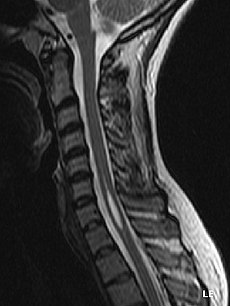
Syringomyelia. See the thin light grey shape inside
the spinal cord, placed at centre in the bottom
half of the above image.
Now, I don't know if he was commenting on my willpower or my stubbornness, but either way I took it as a nice compliment even though I thought it was completely crazy.

We all hear the stories about people who willed away their paralysis. I don't want to say these stories are untrue or that these people are frauds, but often there is a very clear medical reason why some people recover from an injured spinal cord and the vast majority don't. It has a lot less to do with willpower than with what type of injury the person suffered, but because most regular folks aren't experts in spinal cord injury they think that willpower must be one answer.

I think that this thinking also spills over into how people view a successful adjustment to a life with paralysis. People that don't have just enough willpower to cure themselves, but have enough willpower to lead a happy life in the chair. Again, because the media hypes the stories about paralyzed people's success stories, those that aren't so successful end up being thought of as weak.

I guess this comes from people's basic understanding of paralysis, especially paraplegia (just the legs paralyzed). People tend to think of it as an injury that just knocks out your legs and therefore with a strong upper body (and willpower) it should be easy to get used to and lead a normal life. Again, if you can't, it's because of a lack of willpower.

People never think about, because it's never talked about, things like severe neuropathic pain, or pressure sores, or the hundreds of other secondary issues involved with paralysis. In the case of paraplegia, people tend to think that it's just the legs that don't work.

I've got a a new one that people have never thought of. Syringomyelia and I've got it. Basically this is when the spinal fluid enters the spinal cord and causes like a balloon filled with spinal fluid to grow inside the cord which eventually destroys the spinal cord. It often gets longer and goes up the spinal cord leading to sensory dysfunction, pain, weakness, and could lead to quadrapalegia as it gets longer and knocks out the arms.

How did I get this? Lack of willpower? Lack of adjustment to a life of paralysis? No, none of these things matter as you can't will it away or use your willpower to adjust.

No one knows the exact reason why or how it forms, but it forms due to a reaction to a spinal cord injury or hemmorage (which is what I had).

So please keep in mind when you read stories about those leading very successful lives despite their chairs, that not all injuries are the same and not all people suffer secondary complications from their injuries (even though most do and only a small minority lead the lives that you read about in the newspaper).

As of 26 October I'll be writing this blog from the hospital and I get ready for my operation on the 28th and then get moved to a rehab hospital. I'll be letting the surgeon use his skill to get rid of the syringomyelia and then use my skill to keep fighting for a cure for paralysis so things like syringomyelia and all the other complications of spinal cord injury get put into the history books.

Of course you need willpower to not give up hope, but I'm sorry to report, willpower doesn't cure paralysis..

12 October 2011

One or two clicks to cure paralysis


A very important bill, The Regenerative Medicine Promotion Act of 2011, (http://stemcellsandatombombs.blogspot.com/p/regenerative-medicine-promotion-act.html for more information about this bill) has been introduced to the US House of Representatives and now the aim is to also get this bill introduced in the American Senate. Remember, regenerative medicine is the stuff that will get people out of their chairs and walking again!


To do this the bill must have sponsors so it can be introduced. This bill already has one sponsor, Democratic Senator Barbara Boxer, but we need a Republican senator to also sponsor it or it won't get anywhere.


To this end Unite2Fight Paralysis (a grassroots organization dedicated to finding a cure for paralysis - see www.U2FP.org) is sponsoring a face to face lobbying session in Washington on 18 October as part of their Working2Walk conference.


We can't all be there to help in their efforts but you too can help inspire some Republican senators to sponsor this bill by sending the email below. To let them know that people inside and outside of America are looking to the USA for leadership in this very important matter - curing paralysis and a host of other conditions and diseases.


Please send a message to the following US Senators.

The Honorable Mark Kirk (Illinois)

The Honorable Scott Brown (Massachusetts)
The Honorable Susan Collins (Maine)
The Honorable Olympia Snowe (Maine)

This campaign has ended.